Evolution of Tennis and the Racquet
Chapter III
From Solid to Laminated Wood
1874 - 1930
1870s
Wingfield's contributions to the burgeoning sport did not go unnoticed. The new outdoor sport also found support within the Royal Family of Queen Victoria. Prince Edward, the eldest son of Queen Victoria, who would later honor Major Wingfield in 1902 for his 32 years of service to the British Crown, had a remarkable racquet crafted for Wingfield in recognition to his contribution to the emerging sport, featuring an ivory handle upon his return from a trip to India in 1876.

The Wingfield
The Racquet of the Tennis Founder
1876
Wingfield's invention caused significant changes in racquet designs as the game transitioned from indoor courts to outdoor lawns. While Real Tennis racquets were tailored for retrieving balls close to the ground or out of wall corners, the demands of lawn tennis required racquets suitable for playing shots beside the body or even overhead.
Players began favoring frames with a more symmetrical, flat-top design, which proved ideal for overhead shots and the emerging overhead smash stroke. By the mid-1870s, tilt-top shapes had become obsolete in lawn tennis, with flat-top heads becoming the new standard.

The Last Witness
1878
1880s
In 1877, just three years after the birth of Wingfield’s new game, the All-England Croquet Club, seeking funds to repair broken equipment, adapted its croquet fields into tennis courts and hosted the first Wimbledon Championship. The club rejected Wingfield’s hourglass court and modified the rules, creating the version of tennis that soon became global.

Jefferies London
Crafted by the Best 1884

Horsman Maker
The American Touch
1884

A Perfect Past
The 1880s Enigma
1882

Wright & Ditson Surprise
W&D's Stunning Twist
1889

F.H. Ayres The Handicap
A Gentleman’s Choice
1885
The 1880s introduced tennis' first legend. In 1881, John Hartley, the defending champion, entered the court to defend his title. However, just 37 minutes after the opening shot, he had to concede victory to his opponent. This win marked the beginning of William Renshaw’s six-year reign as Wimbledon champion, a record that remains unbroken to this day. Renshaw’s dominance in the tournament became so iconic that the era was dubbed The Renshaw Rush. His success played a key role in establishing Wimbledon as one of the world’s premier tennis events.
Slazenger was the first company to recognize the marketing potential of professional players. In 1885, brothers William and Ernest Renshaw were signed, and the first Slazenger racquets, named after these tennis superstars, were introduced. Produced for 27 years until 1907, the racquet would go on to evolve through all phases of frame design during the period.

Slazenger The Renshaw
The First Player-Endorsed Racquet
1885

Slazenger The Renshaw
From Square to Round shape
1886

Slazenger The Renshaw
From Round to Flat-top
1889
The growing popularity of the sport encouraged manufacturers to experiment with designs, not only in terms of frame shape but also string patterns. Slazenger and Jefferies were at the forefront of these innovations. In addition to standard flat-top frames, they introduced groundbreaking designs that sparked considerable discussion at the time.

Slazenger The Demon
The Fishtail Innovation
1888

Ayres F H Ltd.
A Woven Memory
1883
1890s
As the 1890s progressed, racquet design continued to evolve, transitioning from flat tops to oval heads. From a contemporary perspective, we can speculate that this shift was influenced by advancements in racquet manufacturing technology. While bending wood into rounded shapes was complex and error-prone in the 1880s, by the 1890s, manufacturers had access to more precise tools, making the shaping process more efficient.

Wright & Ditson Longwood
A Wooden Giant
1895

Ormond Club
British Precision, German Exclusivity
1896

Ashes of a Childhood Racquet
The Charred Racquet
1896

Slazenger The Renshaw
From Flat to Oval
1899

Bussey Champion
Build for Durability
1898

Ormond Challenge
A Brand Without Borders
1898

Wilton's Salisbury
The South Wiltshire Sports Club
1895
As seen in the 1880s, some manufacturers continued to innovate, deviating from the general trends. For example, Slazenger’s Demon continued to evolve, adopting a more oval head while retaining its iconic fishtail grip. Other unique grips, like the Fantail, also emerged.


Jefferies Fantail
A Revolution in Grip Design
1893
London Match with Curved grip
History Etched in Patina
1895
Gradidge of Woolwich
Redefining the Grip
1895
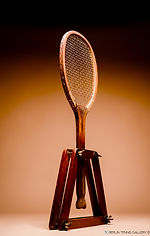
Slazenger The Demon
Innovation with a Tail
1893

Slazenger Special Demon
A Touch of the Extraordinary
1895

Slazenger Special Demon
Elegance meets Accuracy
1898
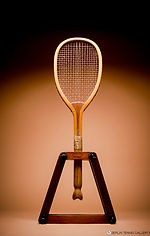
Slazenger The Demon
The Ultimate Refinement
1899

Ekert The Club Glas-type face
The Mermaid Brand
1895
1900s
In the early 1900s, frame design saw little change, though some manufacturers experimented with round or square shapes, such as Victor’s Comet. A notable innovation from this period was Slazenger’s 1898 patent for two additional main strings. The design became widely popular and remained in use until the 1920s.
In 1901, following the death of Queen Victoria, who had ruled for 63 years and was often referred to as the Grandmother of Europe, the Berlin court supplier Steidel produced a commemorative racket in her honor. The original Steidel tribute was never strung or played, remaining in completely untouched, pristine condition, which earned it its name ‘Virgin Queen’.

Gustav Steidel Victoria
The Virgin Queen
1901

Victor The Comet Nr 354
Checkered Craftsmanship
1902

Steidl Practice
The Untouched Classic
1900
Release Date:
pending

Bussey Special Champion
Made for Champions. Time-tested.
1902
Slazenger Pasttime
A Pasttime that lasted
1905
Release Date:
pending

Williams Paris
Inspired by the Iron Lady
1909
Williams Favourite
Red-Tipped Treble Beauty
1908
Release Date:
pending
Ormond Favourite
The Ghost in the Strings
1904
Release Date:
pending
Slazenger The Renshaw
A Legend’s Last Stand
1907
Release Date:
pending
The sport’s international growth continued, particularly following the career of William Renshaw, with the rise of the Doherty brothers. Between 1897 and 1906, Reginald and Lawrence Doherty dominated the scene. Their success, including a Davis Cup win in 1903, spurred a new wave of enthusiasm across Europe.
Slazenger Doherty Flat-top
A Decade of Tennis Dominance
1899
Release Date:
pending
Spring Child Racquet
From Small Hands to Big Courts
1900
Release Date:
pending
Slazenger Doherty L14
Legendary hands. Legendary grip.
1900
Release Date:
pending
Ortrud
A Symbol of Women’s Tennis Heritage
1901
Release Date:
pending
Slazenger Ubique
Ubique by name. Unique by design.
1906
Release Date:
pending
Slazenger EGM Special
A Tribute to E.G. Meers
1903
Release Date:
pending
Release Date:
pending
Slazenger The Demon
Grip the Beast
1905
Release Date:
pending
Bryn Mawr Edw. K. Tryon Co
Ahead of Its Time, Layer by Layer
1905
In 1906, the International Sporting Goods Fair in Leipzig became a stage for innovation in racquet design. Among the standout presentations was the British manufacturer Ormond, operating exclusively within the German market at the time. Their Harlington model received the Gold Medal for Tennis Racquets, a prestigious recognition that underscored its groundbreaking design. The racquet's distinctive feature applying doubled strings in both vertical and horizontal directions wasn´t new at that time but sparked widespread discussion in the tennis world and among equipment specialists. While the concept was never adopted into mainstream production, it remains a remarkable example of early 20th-century experimentation.
Ormond Harlington
Strung in Pairs. Crowned in Gold.
1906
Release Date:
pending
1910s
As racquet design continued to evolve, the wedge shape gradually shifted from convex to concave. Although concave forms had already emerged earlier, it was around the time of World War I that this design began to gain broader traction. One notable example was the “Special” model by the German manufacturer Hammer, which reflected this growing trend.
This shift would go on to shape racquet production for decades to come.
At the same time, the once-popular fish-tail grip was slowly falling out of favour. By the 1910s, it was rarely seen.
Slazenger Carlton
Grace under Pressure
1913
Release Date:
pending
Slazenger Lambert Chambers
A Tribute to the Wimbledon Champ
1914
Release Date:
pending
Slazenger Eclipse
Power in the Shadow
1913
Release Date:
2 Apr 2026
Slazenger Special Score
Made to Settle the Score
1914
Release Date:
4 Apr 2026
Mikado II
Quiet Elegance with an Imperial Echo
1911
Release Date:
6 Apr 2026
Bancroft The Bancroft
A Name that Stood for Itself
1913
Release Date:
8 Apr 2026
Club
Strength in Solid Wood
1918
Release Date:
10 Apr 2026
Hammer Special
The First Chapter of a German Icon
1914
Release Date:
12 Apr 2026
A.R. Dawson Champion
Precision in Every Curve
1912
Release Date:
14 Apr 2026
The 1910s saw the emergence of one of today’s most influential sporting goods manufacturers. In 1913, the Ashland Manufacturing Company was founded in Chicago as a subsidiary of the meat-packing firm Schwarzschild & Sulzberger. Initially specializing in damping products such as tennis strings, violin strings, and surgical sutures made from animal by-products, Ashland laid the groundwork for what would soon become a household name.
In 1914, amid financial difficulties, the company was reorganized under the leadership of Thomas E. Wilson and rebranded as Wilson Sporting Goods. Wilson quickly expanded the product range to include baseball gear, camping equipment, golf clubs, and tennis racquets, positioning the company as a major force in the sporting world. An unused piece from Ashland’s brief and pivotal early chapter remains preserved today.
Ashland (Wilson) Favorite
A Favorite Before Fame
1917
Release Date:
16 Apr 2026
1920s
In the 1920s, tennis became increasingly professional, with stars like Helen Wills, Suzanne Lenglen, Bill Tilden, and the French Musketeers dominating the game. Racquet designs often featured colored cross strings, typically red or green.
Halley & Co. Opresto
Red, Green, and Timeless
1922
Release Date:
19 Apr 2026
Hammer Meteor
Velocity Turned Visible
1920
Release Date:
21 Apr 2026
Bancroft The Premier
First in Name. First in Class.
1923
Release Date:
23 Apr 2026
Wright & Ditson The Park
The Blue Beauty
1928
Release Date:
25 Apr 2026
Steidl Club
Berlin’s Own Favourite
1923
Release Date:
27 Apr 2026
Release Date:
29 Apr 2026
Hammer Meteor
A Strike from the Orbit
1926
Wilson Popular
The Beginner’s Choice
1927
Release Date:
31 Apr 2026
King
Pakistan’s Tribute to George V
1928
Release Date:
2 May 2026
At the same time, manufacturers began experimenting with metal frames, paving the way for the success of the Wilson T2000. The Dayton Steel racquet, produced by the Dayton Company from Ohio, was one of the most popular models of its time, featuring a steel frame and metal wire strings.
Dayton Steel
The Revolution in Metal
1922
Release Date:
4 May 2026
Wright & Ditson made waves in the late 1920s with their Top Flite and X-Pert models, introducing racquets with an open throat area. These designs gained significant popularity and were adopted by many players. One notable player who embraced and popularised the open throat design was the German Cilly Aussem, who made headlines in 1931 by defeating American legend Helen Wills Moody in the Wimbledon final.
Wright & Ditson X-Pert
The Heart of a Gamechanger
1928
Release Date:
6 May 2026
S.B. Special Improved Strung
Innovation in Every String
1924
Release Date:
8 May 2026
While wooden frames continued to dominate, they were prone to warping or bending under stress, particularly when exposed to intense sunlight or strung too tightly.
Darsonval No 9
Stretched Over the Limit
1928
Release Date:
10 May 2026
For the entire 430-year history of tennis racquets up to that point, all frames had been crafted from solid wood. As demonstrated by the warped frame shown above, this posed significant challenges for manufacturers, as the increasing demand became difficult to meet. When companies like BASF invented a new adhesive in the early 1930s, enabling frames to be made using laminated wood, Dunlop was the first to recognize its potential. (Note: Earlier attempts had been made to laminate tennis racquets in a similar manner to furniture construction. However, the adhesives available at the time were prone to failure, causing the wood layers to separate over time, particularly when exposed to heat and moisture.) With the introduction of the Maxply, Dunlop set a new standard for the next 50 years.
Discover more about the revolutionary transition to laminated wood and the game-changing racquets of that era in Chapter IV: From Wood to Composite.