
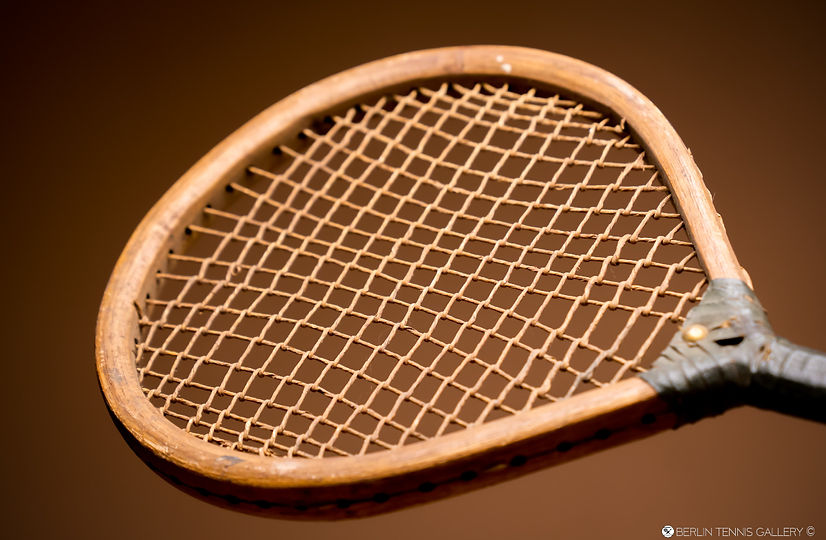
The Strung Battledore
A Glimpse into Victorian Leisure – Origins of Badminton
Manuf.: Garden tennis racquet maker
Model: Strung Battledores
Spec.: Solid wood, trebling stringing system
Year: 1849
(documented or estimated)
Background facts:
Battledore and shuttlecock was played with small racquets, known as battledores, made from wooden frames strung with natural gut. The head was typically round or oval, the handle short. Strung battledores allowed for more precise and controlled play compared to solid or vellum-covered versions.
The well-known 1552 portrait of Charles Maximilian shows a young noble holding a strung racquet of this type. The game has ancient roots and became widespread in Europe from the sixteenth century onward, first as a children’s pastime and later as a leisure activity among the upper classes. The aim was cooperative: players tried to keep the shuttlecock in the air for as many consecutive strokes as possible, without a net or court boundaries.
The form of the strung battledore racquet provided the basis for the later development of the modern badminton racquet.

Practicing Garden Tennis, 1887
Illustrations

Portrait
Face