
Evolution of Tennis and the Racquet
Chapter I
From Hand to Racquet
1000 AD - 1500
The game we now know as tennis took nearly a thousand years to evolve into its modern form. While some evidence suggests that early forms of ball games were played in ancient Egypt, Greece, and Rome, most historians trace its direct origins to French monasteries around the year 1000 AD. Here, monks played jeu de paume, the “game of the palm,” striking a wooden ball with the bare hand or with a simple leather glove across a rope stretched through the cloister courtyard. The game spread quickly across northern France and became a favorite among clergy and students.
By the thirteenth century, players began using gloves reinforced with parchment, followed by small wooden paddles. These gradually evolved into rackets, and the balls were refined from solid wood to stitched leather filled with wool, sand, or sawdust. Written accounts from this period describe paumiers, early ball-makers who specialized in shaping and sewing these leather balls by hand. During the fourteenth and fifteenth centuries, jeu de paume left the monasteries and entered royal courts. King Louis X of France, known as le Hutin, was an enthusiastic player and is even recorded as having died after an exhausting match in 1316. His successor, Charles V, ordered the construction of indoor courts in Paris, which marked the beginning of tennis as an enclosed sport. By the fifteenth century, dedicated courts had appeared in nearly every major French and Burgundian city, and the game had become an essential part of aristocratic culture.
A mid-1980s advertisement by Snauwaert later recalled these beginnings, depicting the early monks’ gloves designed for jeu de paume as the distant ancestors of the modern racquet. This long evolution, from a palm game in monastery courtyards to an organized indoor sport of the nobility, laid the foundation for what would, centuries later, become tennis.

Snauwaert advertisement "History of Tennis", 1986
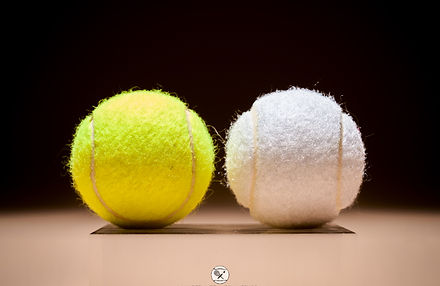
Let’s take a closer look at how the tennis ball developed over time. When the French introduced jeu de paume in the Middle Ages, balls were handmade from materials such as wood, cork, cloth, wool, and tightly wound leather. The leather versions, usually filled with horsehair, became the preferred type and were still used in France and England during the eighteenth century. Their weight and irregular bounce suited indoor play on stone floors and paved courts. A decisive step came with the discovery of vulcanization by Charles Goodyear in 1839, completed in 1844. This chemical process made rubber elastic and durable, allowing the first hollow balls with controlled rebound. By the 1870s, manufacturers in England produced rubber balls specifically for lawn tennis, which had just been standardized by Major Walter Clopton Wingfield under the name Sphairistikè. These early balls were covered in flannel or worsted wool and stitched by hand.
By 1882, the firm John Heathcote & Co. in Derbyshire began industrial production, followed later by Slazenger and Ayres. The use of pressurized air inside the core was introduced in the early twentieth century, which gave the ball a consistent bounce on grass, clay, and later hard courts. White balls dominated for nearly a hundred years and were used in every Grand Slam tournament. In 1972, the International Tennis Federation (ITF) approved the color optic yellow after optical studies showed that yellow was more visible to television cameras and viewers. Major tournaments gradually adopted the new standard, while Wimbledon retained white balls until 1986. On 7 July 1985, Boris Becker, aged seventeen, won the last Wimbledon final played with white balls, becoming the youngest champion in the event’s history. When he defended his title in 1986, he used yellow balls, symbolizing the complete shift to modern televised tennis. Today, each official ball used in competition must meet precise ITF standards of weight, diameter, rebound, and deformation, ensuring uniform play across all surfaces worldwide.
How did the racquet become part of the game? To understand this, we must look at the political landscape of late medieval Europe. Large parts of France were occupied by the Anglo-Saxons, and wherever territories changed hands, cultural exchange followed. The English nobility, already familiar with racquets from other sports, developed an interest in jeu de paume and combined its basic principles with the use of a racquet to strike the ball.
The result was a new game, soon known as "Real Tennis" or "Royal Tennis". A pastime reserved for the elite. Henry VIII of England was one of its most enthusiastic supporters, commissioning numerous courts across the country. The oldest known depiction of a tennis racquet appears in a 1555 book by the Italian priest and philosopher Antonio Scaino. A replica of this historic Scaino racquet is on display at the Berlin Tennis Gallery.

The Scanno Racquet
1555

Medieval men playing wall tennis, checkers and hoops with Scanno-like racquets
All objects discussed in this chapter are part of the complete Evolution collection.
In Chapter II: From Royal to Lawn Tennis, we explore how Royal Tennis continued to evolve and ultimately gave rise to the modern sport as we know it today.